
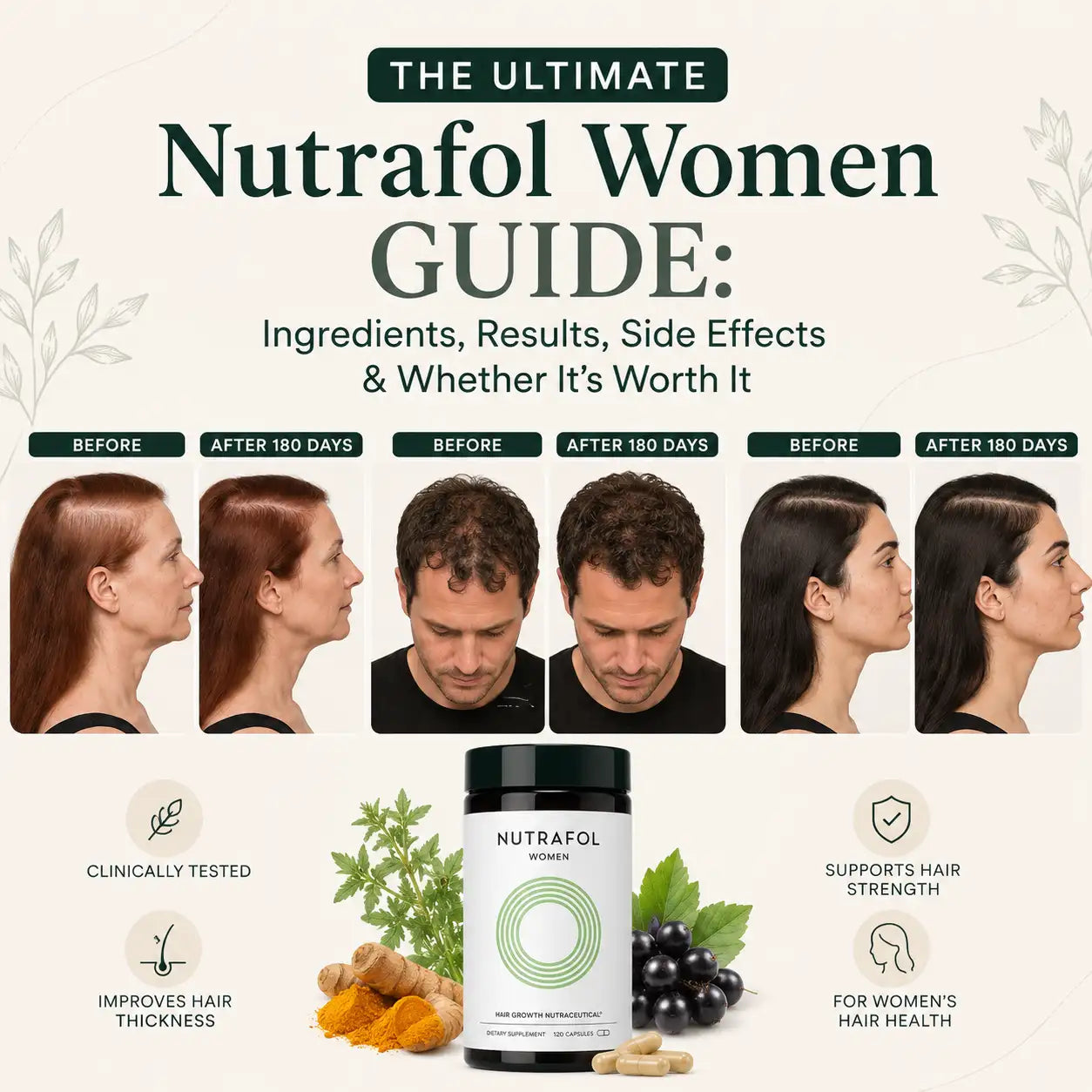
The Ultimate Nutrafol Women Guide: Ingredients, Results, Side Effects & Whether It's Worth It
If you've watched your ponytail get thinner, noticed more strands circling the shower drain, or spotted a widening part in the mirror, you've probably come across Nutrafol women while searching for answers. It's one of the most talked-about hair growth supplements on the market, recommended in dermatology offices and praised across thousands of reviews. But it's also expensive, slow to work, and surrounded by a lot of marketing noise. This guide cuts through that noise.
What follows is a balanced, practical breakdown written for women in the UK, USA, Canada, and Australia who want to make an informed decision rather than an impulsive one. We'll look honestly at what Nutrafol can and can't do, who it actually suits, and how it stacks up against the alternatives.
Featured Answer: What Is Nutrafol Women?
Nutrafol Women is a daily nutraceutical hair growth supplement formulated to target common drivers of female hair thinning, including stress hormones, nutrient gaps, and inflammation. It combines botanical extracts, marine collagen, and vitamins, and is designed to be taken consistently for three to six months before results appear.
Shop Nutrafol Hair Growth Solutions
What Is Nutrafol for Women?
Nutrafol is a physician-formulated dietary supplement marketed specifically for hair growth support. The women's range is segmented by life stage, with separate formulations for general women's needs, postpartum recovery, women aged 45 and over (often called the Balance formula), and vegan users.
Rather than positioning itself as a drug, Nutrafol sits in the nutraceutical category, meaning a food-derived product with claimed health benefits. The premise is that hair thinning in women rarely has a single cause. Hormones, chronic stress, poor sleep, micronutrient deficiencies, and inflammation can all push hair follicles out of their growth phase prematurely. Nutrafol's approach is to address several of these pathways at once rather than targeting just one.
It's worth being clear from the outset: this is a supplement, not a miracle cure, and not a replacement for medical treatment when there's an underlying condition driving your shedding.
How Does Nutrafol Women Work?
To understand the rationale behind any hair growth supplement, it helps to understand the hair growth cycle. Each follicle moves through three phases: the anagen phase (active growth), the catagen phase (a short transitional stage), and the telogen phase (resting, after which the hair sheds). At any moment, most of your hair sits in anagen. Problems arise when too many follicles shift into telogen at once, a pattern dermatologists call telogen effluvium, leading to noticeable hair shedding.
Nutrafol's formulation targets several proposed contributors to this disruption. Ashwagandha, an adaptogen, is included to help moderate cortisol, the stress hormone linked to increased shedding. Saw palmetto is added for its proposed role in modulating DHT (dihydrotestosterone), a hormone derivative associated with follicle miniaturisation in genetically susceptible women. Marine collagen and a blend of antioxidants and vitamins aim to support the follicle environment and overall scalp health.
The intended outcome is to keep more follicles in the growth phase for longer, gradually improving hair density and supporting hair regrowth over a period of months. It's a cumulative, biological process, which is precisely why patience matters so much with this product.
Nutrafol Women Ingredients Explained
The formulation is what sets Nutrafol apart from cheaper biotin tablets, and it's worth knowing what you're actually paying for. The core ingredients across the women's range typically include:
Ashwagandha (Sensoril) — a standardised adaptogen included to help manage stress-related cortisol levels, which can contribute to female hair thinning.
Saw Palmetto — a botanical traditionally used to support healthy DHT levels.
Marine Collagen — a peptide source intended to support the skin and scalp matrix in which follicles sit.
Biotin — a B-vitamin commonly associated with hair and nail health, though deficiency is rare in well-nourished people.
Curcumin (from Turmeric) — included for its antioxidant and anti-inflammatory properties.
Tocotrienols (Vitamin E complex) — antioxidants studied in the context of scalp health.
Hyaluronic Acid, Horsetail, Resveratrol, and a vitamin-mineral base including vitamins A, C, D, zinc, and selenium round out the formula.
The thinking behind this combination is synergy: rather than mega-dosing one nutrient, the formula provides moderate amounts across multiple pathways. That's a reasonable scientific rationale, though as we'll discuss, multi-ingredient formulas make it harder to know which component is doing the heavy lifting.
Benefits of Nutrafol Women
When it works, and for the right person, the reported benefits are meaningful. Users frequently describe reduced hair shedding within the first few months, which is often the earliest and most encouraging sign. Over a longer period, some report improved thickness, more baby hairs along the hairline, and hair that feels stronger and less prone to breakage.
Beyond hair, the adaptogenic and nutrient components mean some women notice secondary effects such as better nail strength or a subjective sense of feeling more balanced under stress. The convenience of a single daily regimen, the physician-formulated positioning, and the fact that many dermatologist recommendations include Nutrafol all add to its appeal as a credible option within the crowded hair growth supplements for women category.
It's also drug-free, which matters to women who can't or prefer not to use medicated topical treatments, and to those seeking natural hair growth support during sensitive periods such as breastfeeding (always with medical clearance first).
Limitations You Should Know About
No honest guide would stop at the benefits. Nutrafol has real limitations worth weighing.
The most significant is cost. At a premium monthly price, sustained over the six-plus months needed to judge results, the investment is considerable, and it's an ongoing one. Stop taking it, and gains tend to fade over subsequent months because the underlying biology hasn't changed.
The evidence base, while present, is limited and largely funded by the manufacturer. Independent, large-scale, long-term trials are scarce. Results are also highly variable: the same product that transforms one woman's hairline does very little for another, particularly if her thinning has a cause the supplement doesn't address, such as thyroid dysfunction, iron deficiency, or genetic female pattern hair loss requiring medical treatment.
Finally, supplements like this are best seen as one part of a broader approach, not a standalone fix.
Realistic Expectations
Here's the honest version many marketing pages skip. Nutrafol is not going to regrow hair in bald areas where follicles are no longer viable. It works best on follicles that are thinning or underperforming, not those that are gone.
For most users who respond, the realistic ceiling is reduced shedding, modestly improved density, and healthier-looking hair, not a dramatic reversal. Manage your expectations toward "noticeably better" rather than "completely restored," and you're far more likely to feel the product was worth it.
Common Mistakes People Make
The single biggest mistake is quitting too early. Many women stop at six or eight weeks, conclude it isn't working, and miss the window where results typically begin. Hair biology is slow, and the first months often show no visible change at all.
Other frequent errors include taking it inconsistently, expecting it to override an untreated medical cause, skipping a dermatologist visit before starting, and neglecting the basics, sleep, diet, iron and vitamin D status, and gentle hair handling, that influence outcomes just as much. Some women also layer multiple supplements with overlapping ingredients, risking excessive intake of fat-soluble vitamins.
Shop Nutrafol Hair Growth Solutions
Nutrafol Women Timeline: What to Expect Month by Month
While individual results vary, a typical trajectory looks something like this:
Months 1–2: Usually no visible change. Some users notice reduced shedding toward the end of this window. This is the patience-testing phase.

Months 3–4: Shedding often stabilises further; some begin to notice short regrowth or "baby hairs," and hair may feel stronger.

Months 5–6: This is when visible improvements in density and thickness are most commonly reported. This is the realistic point to judge whether it's working for you.

Beyond 6 months: Continued, gradual maintenance and improvement, provided you keep taking it consistently.
If you've seen no change whatsoever by month six, it's a strong signal to revisit the cause of your thinning with a professional.
Research & Evidence
Nutrafol points to clinical studies suggesting improvements in hair growth and quality among users. These studies do exist and show positive signals, which is more than can be said for many supplements that rely purely on testimonials.
However, the scientific rationale outpaces the independent evidence. Several of the available studies are manufacturer-sponsored, relatively small, and shorter than ideal for a condition that evolves over years. Individual ingredients like saw palmetto and ashwagandha have their own bodies of research, but the specific proprietary blend hasn't been extensively validated by independent groups.
This doesn't mean the product doesn't work. It means the honest position is "promising, with a reasonable mechanistic basis, but not definitively proven to the standard of a pharmaceutical." That's a fair frame to bring to any nutraceutical, and a more trustworthy one than the marketing suggests.
Who Nutrafol Women Is Best For
Nutrafol tends to suit women experiencing diffuse thinning or increased shedding linked to stress, life transitions, or general nutrient and hormonal factors, rather than advanced, patterned baldness. It's a strong fit for those who prefer a drug-free, natural hair growth support approach, who can commit financially and behaviourally to at least six months, and who have ruled out treatable medical causes.
It also appeals to women in perimenopause or menopause noticing age-related thinning, and to those recovering from postpartum shedding who want gentle support.
Who Should Avoid It
Nutrafol isn't right for everyone. If your thinning stems from an untreated medical condition, an iron or thyroid issue, a scalp disorder, or rapid sudden hair loss, you need a diagnosis first, not a supplement. Pregnant women, and anyone on medication that could interact with the botanical ingredients, should consult a doctor before starting, as should those with shellfish allergies given the marine collagen.
Anyone unwilling or unable to sustain the cost long-term should also think twice, since stopping reverses the gains. And if you want guaranteed, dramatic regrowth, no supplement can promise that.
Frequently Misunderstood Facts
A few persistent myths are worth correcting. Nutrafol is not a medication and doesn't contain minoxidil or finasteride; comparing it directly to those is comparing different categories. It also doesn't "detox" your scalp or work overnight, despite how some social content frames it.
Another misunderstanding: more biotin does not mean more hair. Beyond correcting a genuine deficiency, extra biotin offers little benefit and can skew certain lab tests. And "natural" does not automatically mean "side-effect-free", botanicals can still interact with medications.
Nutrafol Women Side Effects
Nutrafol is generally well tolerated, but no supplement is entirely without risk. The most commonly reported side effects are mild and digestive: nausea, stomach upset, or bloating, often reduced by taking the capsules with food. Some users report mild headaches or, paradoxically, temporary increased shedding in the very early weeks as follicles cycle, which typically settles.
Because the formula contains botanicals like ashwagandha and saw palmetto, there's potential for interactions with hormone-sensitive conditions or certain medications. The marine collagen makes it unsuitable for those with shellfish allergies. As always, the responsible move is a quick conversation with your GP or dermatologist before starting, especially if you take other medications.
Nutrafol Women Before and After: What Real Results Look Like
Search for nutrafol women before and after and you'll find a spectrum, from striking transformations to modest, honest "it helped a bit" updates. Both are real. The dramatic photos usually involve good lighting, consistent use over six to twelve months, and follicles that were thinning rather than lost.
The more representative result is subtler: less hair in the brush, a slightly fuller part line, and regrowth visible as fine hairs along the hairline. When evaluating before-and-after images, look for consistent lighting, the same hairstyle and angle, and a realistic timeframe. Be sceptical of anything promising visible change in a few weeks.
How Nutrafol Women Compares to Alternatives
Nutrafol doesn't exist in a vacuum. Here's how it sits against common alternatives in the hair growth vitamins and treatment space.
| Comparison Point | Nutrafol Women | Viviscal | Vegamour | Topical Minoxidil | Basic Biotin |
|---|---|---|---|---|---|
| Approach | Multi-pathway nutraceutical | Marine protein supplement | Plant-based supplement & serum | Medicated topical | Single vitamin |
| Drug-free | Yes | Yes | Yes | No | Yes |
| Targets stress/DHT | Yes | Limited | Partial | No (different mechanism) | No |
| Typical cost | High | Moderate | Moderate–high | Low–moderate | Very low |
| Time to results | 3–6 months | 3–6 months | 3–6 months | 2–4 months | Minimal effect alone |
| Best for | Diffuse stress/hormonal thinning | General thinning | Natural-preference users | Pattern hair loss | Correcting deficiency only |
The takeaway: Nutrafol justifies its premium through breadth and formulation quality, but it isn't automatically superior. For pattern hair loss with a genetic basis, a medicated option like minoxidil (or a combined approach) may outperform any supplement. Brands like Hims and Hers, and their women's lines, tend to lean toward medicated and prescription routes, a different philosophy from Nutrafol's drug-free positioning.
Shop Nutrafol Hair Growth Solutions
Quick Answers
How long does Nutrafol take to work? Most women see early reductions in shedding around months two to three, with visible density improvements typically appearing between months four and six. Consistent daily use is essential, and six months is the fair point to judge results.
Is Nutrafol worth the money? It can be, for women with diffuse, stress-related, or hormonal thinning who can commit to six-plus months and have ruled out medical causes. For untreated medical hair loss or advanced pattern baldness, the money may be better spent on a diagnosis first.
Related Concepts & Terminology
Understanding the vocabulary around hair loss helps you make better decisions and communicate clearly with professionals.
Hair follicle — the structure in the skin from which each hair grows. Hair density — the number of hairs per area of scalp. Hair growth cycle — the repeating sequence every follicle moves through. Anagen phase — the active growth stage. Catagen phase — the brief transitional stage. Telogen phase — the resting stage before shedding. Telogen effluvium — excessive shedding when many follicles enter telogen at once. DHT (dihydrotestosterone) — a hormone derivative linked to follicle miniaturisation. Follicle miniaturisation — the gradual shrinking of follicles that produces finer hair. Scalp health — the condition of the skin and environment supporting follicles. Nutraceuticals — food-derived products with claimed health benefits. Hair shedding versus hair regrowth — the loss and renewal sides of the cycle. Dermatologist recommendations — professional guidance that should anchor any serious approach to hair loss.
People Also Ask
Does Nutrafol really work for women? For many women with diffuse or stress-related thinning, yes, to a modest degree, with reduced shedding and improved density reported over several months. Results vary and it works best when no untreated medical cause is present.
Can I take Nutrafol with other supplements? Often yes, but watch for overlapping ingredients, especially fat-soluble vitamins and biotin. Check with a healthcare provider if you take medications or other hair supplements.
Does hair fall out more when starting Nutrafol? Some users notice a temporary increase in shedding in the first few weeks as follicles cycle. This usually settles. Persistent heavy shedding warrants a medical review.
Is Nutrafol FDA approved? No. As a dietary supplement, it isn't FDA approved in the way medications are; supplements are regulated differently. The same applies to equivalent bodies in the UK, Canada, and Australia.
What happens if I stop taking Nutrafol? Benefits typically fade over the following months because the underlying drivers of thinning haven't changed. Maintaining results generally requires ongoing use.
Is Nutrafol better than biotin? For most people, yes, because biotin alone rarely helps unless you're deficient, whereas Nutrafol targets multiple pathways. Biotin is far cheaper but far narrower.
Can younger women take Nutrafol? Yes, the standard women's formula suits most adult women, though the cause of thinning matters more than age. A professional assessment is wise for younger women with sudden loss.
Does Nutrafol help with postpartum hair loss? It's often used for postpartum shedding, and there's a dedicated postpartum formula. Postpartum shedding frequently resolves on its own, so supplementation is supportive rather than essential.
Is Nutrafol safe long-term? It's generally well tolerated for ongoing use, but long-term independent safety data is limited. Periodic check-ins with a healthcare provider are sensible.
Can I take Nutrafol while breastfeeding? Only with medical clearance. Some botanical ingredients aren't well studied in breastfeeding, so professional guidance is essential.
Is This Right For You?
If you're weighing up whether to buy, here's a clear decision framework.
You should consider Nutrafol if you have diffuse thinning or increased shedding linked to stress, hormones, or life stage; you prefer a drug-free approach; you've ruled out treatable medical causes; and you can realistically commit to at least six months of consistent use and ongoing cost.
You should probably skip it if your hair loss is sudden, patchy, or rapidly progressing (see a doctor first); you have an untreated thyroid, iron, or hormonal condition; you're unable to sustain the cost long-term; or you expect dramatic regrowth in weeks.
Key buying considerations: confirm you're choosing the right formula for your life stage (standard, postpartum, 45+, or vegan), budget for a minimum six-month trial rather than a single bottle, and ideally start after a dermatologist consultation so you're treating the right problem.
Expected commitment level: high. This is a daily habit measured in months, not weeks, and the financial commitment is ongoing. Going in with that clarity is the single best predictor of satisfaction.
If you're navigating thinning hair, the smartest first step isn't buying a supplement, it's understanding your specific cause. From there, nutrafol women becomes one well-formulated, evidence-informed option among several, best chosen deliberately rather than impulsively.
Frequently Asked Questions
1. What is Nutrafol Women and who is it for? It's a daily, drug-free hair growth supplement formulated for women experiencing thinning or increased shedding, particularly from stress, hormones, nutrient gaps, or life transitions like postpartum and menopause.
2. How quickly will I see results? Most women notice reduced shedding around months two to three, with visible density improvements typically appearing between months four and six. Six months is a fair point to judge effectiveness.
3. What are the main Nutrafol Women ingredients? Key ingredients include ashwagandha, saw palmetto, marine collagen, biotin, curcumin, tocotrienols, and a vitamin-mineral base, chosen to target multiple drivers of thinning at once.
4. Are there Nutrafol Women side effects? Most are mild and digestive, such as nausea or bloating, often eased by taking capsules with food. Botanical ingredients can interact with some conditions and medications, so check with a doctor first.
5. Is Nutrafol Women safe during pregnancy or breastfeeding? Not without medical clearance. Some ingredients aren't well studied in pregnancy or breastfeeding, so always consult your healthcare provider before starting.
6. Does Nutrafol contain anything for shellfish allergies to worry about? Yes. It contains marine collagen, so it isn't suitable for people with shellfish allergies.
7. How does Nutrafol compare to Viviscal? Both are drug-free supplements with similar timelines. Nutrafol targets more pathways, including stress and DHT, while Viviscal centres on a marine protein complex. Nutrafol is typically more expensive.
8. Is Nutrafol better than minoxidil? They're different categories. Minoxidil is a medicated topical often more effective for pattern hair loss, while Nutrafol is an oral, drug-free, multi-pathway supplement. Some people use complementary approaches under guidance.
9. Which Nutrafol formula should I choose? Choose based on your life stage: the standard women's formula, postpartum, women's balance for 45+, or vegan. The cause of your thinning matters more than the label alone.
10. Will my hair fall out if I stop taking it? Gains generally fade over subsequent months because the underlying causes remain, so maintaining results usually requires ongoing use.
11. Can I take Nutrafol with biotin or other vitamins? Often yes, but watch for overlapping ingredients to avoid excessive intake of biotin or fat-soluble vitamins. Check with a provider if combining supplements.
12. Does Nutrafol work for menopausal hair thinning? It's commonly used for age-related and hormonal thinning, with a dedicated 45+ formula. Results are typically modest improvements in density and shedding rather than full reversal.
13. Is the cost justified? For the right candidate committing to six-plus months, many feel it is. For undiagnosed medical hair loss, investing in a diagnosis first is wiser.
14. Do I need a prescription? No. Nutrafol is sold as a dietary supplement and doesn't require a prescription, though a professional consultation before starting is recommended.
15. What should I do if Nutrafol doesn't work after six months? Treat it as a signal to revisit the cause with a dermatologist. Persistent thinning despite consistent use suggests an underlying issue that may need targeted medical treatment.
Shop Nutrafol Hair Growth Solutions
Conclusion
Nutrafol women has earned its reputation as one of the more thoughtfully formulated hair growth supplements available, with a credible multi-pathway rationale, genuine dermatologist interest, and many satisfied users. But it isn't magic, it isn't cheap, and it isn't right for everyone. Its strengths are real: a drug-free approach, broad formulation, and meaningful results for the right person. So are its limitations: a premium ongoing cost, modest and variable outcomes, and an evidence base that's promising rather than conclusive.
The honest bottom line is this. If you have diffuse, stress-related, or hormonal thinning, you've ruled out treatable medical causes, and you can commit to six months and the ongoing investment, Nutrafol is a reasonable, evidence-informed choice worth trying. If your hair loss is sudden, patchy, or undiagnosed, see a professional first. Treat any supplement as one part of a bigger picture that includes sleep, nutrition, stress, and proper diagnosis, and you'll make a decision you won't regret.